SPARE PARTS
Imported spare parts: sizing a safety stock that works
When a critical part comes from abroad, lead time is counted in weeks, not hours. Safety stock stops being a comfort: it is what separates a two-hour stoppage from a two-week one.
Why the usual formula is not enough
The classic safety-stock formula combines average consumption, replenishment lead time and a standard deviation of demand. It works well when the lead time is short and predictable.
It becomes misleading as soon as the part is imported, for three reasons: the real lead time varies widely from one order to the next, it includes steps you do not control, and the minimum order quantity is often set by the supplier.
In practice the lead time that matters is not the shipping time, but the total replenishment lead time: detecting the need, budget approval, ordering, manufacture or picking at the supplier, freight, customs formalities, receiving and quality control. Each step can add days the formula ignores.
Size the stock on criticality, not on value
The natural reflex is to stock what is expensive. That is a reasoning error: what matters is the impact of a stock-out, not the price of the part.
Classify every reference on two axes: the probability of failure, and the severity of the stoppage it would cause. An 80-dirham part that halts a whole line deserves more stock than an 8,000-dirham component whose absence can be worked around.
| Profile | Long lead time | Short lead time |
|---|---|---|
| Critical — immediate production stop | Safety stock mandatory, quantity ≥ 1 | Buffer stock, replenishment monitored |
| Important — throughput degradation | Safety stock of 1 unit | On order, with an alert threshold |
| Standard — a workaround exists | On order | On order |
The 80/20 rule almost always applies: a small minority of references causes the majority of long stoppages. Concentrate stocking and monitoring effort on those.
The real cost of a stock-out, next to the stock
Safety stock has a cost: tied-up cash, space, obsolescence risk. A stock-out has a cost that is far harder to defend in a meeting.
To arbitrate, put numbers on both sides:
- Cost of one hour of stoppage on the line concerned (lost output, overtime, possible late-delivery penalties).
- Expected stoppage duration if the part is missing: that is the replenishment lead time, not the repair time.
- Annual cost of holding the stock: tied-up value, obsolescence, handling.
The arithmetic is usually one-sided: for a critical part with a multi-week lead time, the cost of a single avoided stoppage exceeds several years of storage.
Organise the tracking without adding work
Safety stock is worthless if it is consumed and never rebuilt. Three mechanisms are enough to prevent drift.
- A minimum level per critical reference, raising an alert as soon as it is crossed — not when stock reaches zero.
- A stock movement recorded for every issue, linked to the work order that consumed it. That link is what tells you which asset consumes which part.
- A periodic review of the thresholds, because an ageing fleet does not consume the same references.
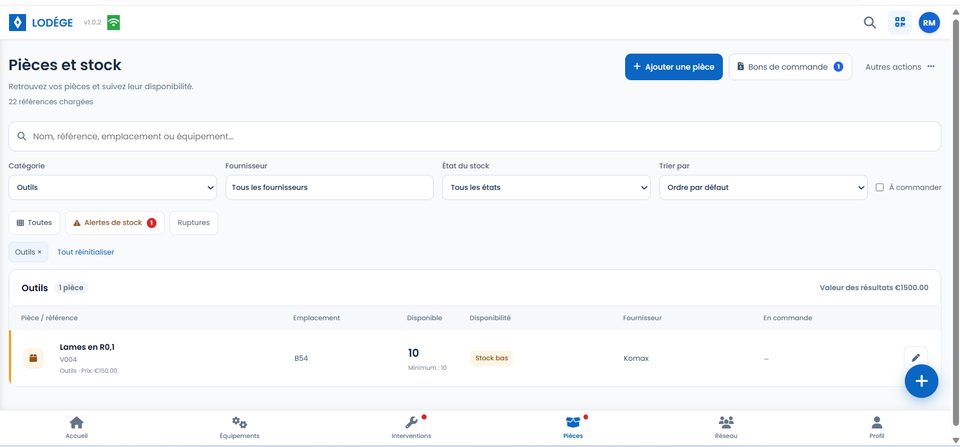
Track the value of the stock, not just the quantities
A quantity tells management nothing. The value of the stock, how it moves, and consumption per period are the numbers that justify a budget.
The goal is not to reduce stock — it is to shift it towards the references that genuinely protect production.
A concrete case: the critical part with a long lead time
Here is how the decision looks, on a simple example. A part fits a machine whose stoppage costs 4,000 dirhams per hour. Its real replenishment lead time is 5 weeks, and the part costs 2,500 dirhams.
Before comparing, one distinction is essential, because it decides how the case will be received:
- Direct costs are attributable to the intervention itself: repair labour, the part, consumables, possibly express freight.
- Indirect costs are the consequences of the stoppage: lost output, overtime, delivery delays, penalties. They appear on no maintenance invoice, which is exactly why they are underestimated.
Direct answer to the obvious question: of the 4,000 dirhams per hour, all of it is indirect. No stoppage hour appears on a supplier invoice — it is lost margin. And mind the reading: 5 weeks of continuous stoppage is not a credible scenario. You find express shipping, a second-hand part, local machining, or you borrow a part from another machine. The table therefore prices a high bound, not a forecast.
| Scenario | Direct costs | Indirect costs (lost output) |
|---|---|---|
| Part in safety stock | 2,500 DH (the part, bought in every scenario) + 2 h of labour | 2 h × 4,000 DH = 8,000 DH |
| No stock, express shipping within 1 week | 2,500 DH + express freight + 2 h of labour | Residual stoppage, depending on the workaround found |
| No stock, waiting for the normal lead time | 2,500 DH + 2 h of labour | 840 h × 4,000 DH = 3,360,000 DH |
Where do the 840 hours come from? That is the duration of the stoppage, not the repair time. The replenishment lead time is 5 weeks and the machine runs continuously (3 shifts), so: 5 weeks × 7 days × 24 h = 840 hours of unavailability. The repair itself takes only 2 hours, but it cannot start before the part arrives. If your plant only runs days, replace 24 with the hours actually worked per day.
The point is not the figure in that last row, which is unrealistic, but the order of magnitude of the gap. Even if you lose only 1% of that high bound, 33,600 dirhams, the safety stock pays for itself more than ten times over. And the middle row, more credible, shows that express shipping is still expensive: that is the price of improvising.
The practical conclusion: indirect costs are what justify the stock, and they are what you must quantify before asking for a budget.
What to remember
- The lead time that matters is the total one, from detecting the need to controlled receipt.
- Stock according to criticality, not price.
- Always separate direct and indirect costs: lost output decides, not the invoice for the part.
- Safety stock only survives if it is rebuilt automatically after consumption.
- The value of the stock and its consumption are the two numbers to put in front of management.
Sources
- ISO 55000 — Asset management — Asset management framework: arbitrating between performance, cost and risk, to which a spare-parts policy attaches.
Read next
See these principles in practice
LODÉGE brings work orders, equipment, parts and metrics into one application, available from the office and in the field.